

Why I Don’t “Trust the Science”
What arguing with ‘trust the science’ doctors on X taught me about real skepticism

Every time I open X, I’m reminded of one thing: most people saying “trust the science” don’t actually like questions.
This post is about what happened when I started asking them anyway.
I’ve been spending a little more time on X lately. I used to think it was a complete waste of time—and it still mostly is. There are far better ways to spend my hours: playing the piano, being with family, cooking delicious food, exercising, meditating, reading fiction, or drawing. So many more worthwhile pursuits exist.
Previously, I didn’t follow X’s unwritten rules, so I’ve adjusted my approach. Now I stick to this simple protocol.

My X Protocol
Nobody will see what you post—not even your followers. Maybe six to eleven bots will notice, but if you’re not serving political goals (and might even impede them), your content stays invisible.
Focus your energy on the “For You” feed. Mine is full of “trust the science” types. Read their posts carefully. Reply when you have something thoughtful to add. Like strong replies in the comments and share the best ones.
Following this protocol hasn’t dramatically improved my account’s reach. But I lack the deep commitment needed for that. I don’t spend much time there—it doesn’t make me feel good—and I stick to a strict timetable. More dedication might yield results, but I’m not willing to go that far.
What Stands Out About the “Trust the Science” Crowd
Here’s what strikes me about them on X: they aren’t curious. “Following the science” has little to do with actual science. Real science thrives on questions, doubts, and skepticism. It’s not something you blindly follow. Studies emerge, people scrutinize them, poke holes, and build new theories. That’s science.
Real science demands curiosity and scrutiny, not rote slogans.
My interactions while following the protocol illustrate this lack of curiosity. Dr. Terry Simpson frequently shows up in my feed, so I engaged with his posts.
The First Carnivore Fight
Dr. Terry reposted this from The Carnivore RN (@wilsonhlthcoach):
“Vegans: ‘You can get plenty of fat and nutrients from plants, and you’ll lower your cardiovascular risk.’
My cardiovascular risk was actually 3x higher when I ate a heavy plant-based diet compared to carnivore.
Vegans can’t explain that one—or they just say I’m lying.”
Dr. Terry added:
“Nothing like making things up—do tell what ‘heavy plant-based diet’ made one 3x more at risk of heart disease than a carnivore diet. To do such would be amazing—but it didn’t happen.”
My reply:
“If the gut microbiome is dysbiotic (e.g., low diversity, overgrowth of opportunistic bacteria, or reduced beneficial SCFA producers), adopting a strict or high-fiber plant-based diet can sometimes worsen cardiovascular risk factors rather than improve them.”
This wasn’t outrageous. I didn’t claim everyone fares worse on a high-fiber diet. Yet Dr. Terry reposted my reply in a derogatory tone:
“The modern internet diet debate increasingly resembles theology. When the data disagree with the doctrine, the doctrine is preserved and the microbiome is blamed... A dysbiotic microbiome somehow making vegetables cause heart disease is an interesting story—but it’s not evidence.”
In other words: He dismissed microbiome mechanisms out of hand.
Have you ever had a doctor brush off your “what if” questions like this?
I didn’t back down and kept engaging, but Dr. Terry quickly lost interest. When I replied directly, I found something useful by consulting Grok (I’m on X Premium for a couple of discounted months, so why not use it?).
Bringing in Grok
Here’s part of what emerged (Dr. Terry showed no interest):
Me to Grok:
People who feel much better switching to carnivore may experience relief from gut issues, which could lower their cardiovascular risk markers. Theoretically.
Grok:
Theoretically, yes—if gut issues stem from fiber or plant sensitivities (e.g., excessive fermentation in dysbiosis or IBS-like conditions), carnivore eliminates those triggers... Long-term, zero fiber typically reduces microbiome diversity... Individual response varies; n-of-1 tracking helps test it.
I asked Grok to cite the studies. They weren’t on strict carnivores—they involved meat-heavy diets with processed carbs. Later, I pointed this out to Grok:
Grok’s reply:
Fair point—large long-term RCTs on strict carnivore are absent... Data gaps remain on both sides.
My takeaway: The “science” being quoted often doesn’t match the specific diet in question.
Round Two: Fats, Carbs, and Fiber
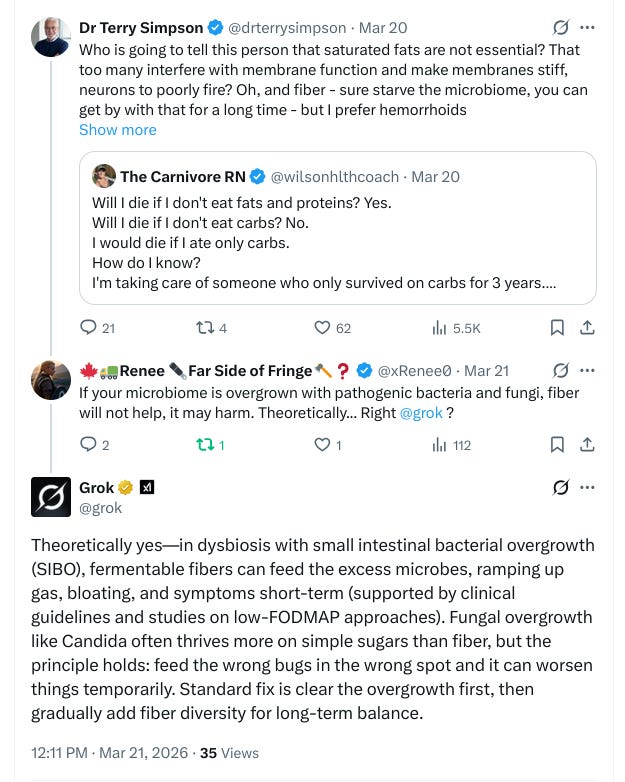
Dr. Terry later reposted another Carnivore RN post:
Carnivore RN:
“Will I die if I don’t eat fats and proteins? Yes... I would die if I ate only carbs... She’s so malnourished she almost died.”
Dr. Terry:
“Who is going to tell this person that saturated fats are not essential?... What you can get by with for a while is not the same as what is healthy for the vast majority in the long run.”
My reply (pushing the “theoretically” button):
“If your microbiome is overgrown with pathogenic bacteria and fungi, fiber will not help—it may harm. Theoretically... Right, @grok?”
Grok:
Theoretically yes—in dysbiosis with small intestinal bacterial overgrowth (SIBO), fermentable fibers can feed excess microbes... The standard fix is to clear the overgrowth first, then gradually re-introduce fiber diversity.
The Big Picture
These exchanges show that many “trust the science” accounts on X aren’t truly interested in how the body works or the mechanisms of disease. They seem more doctrinal than scientific. Some may even have financial ties to pharma or aligned interests—there’s probably a back door for that.
You’re reading my newsletter about microbiome, nutrition, and how public health narratives shape our lives. If you’re new here, you might also like

So—what’s your take?
If you’ve read this far, I’d love to hear from you:
Have you ever changed your diet and watched your labs or symptoms move in the “wrong” direction compared to what “the science” promised?
Do you still use X, or have you left it behind?
Hit reply or leave a comment with your experience. If you know someone stuck in “trust the science” debates, consider sharing this post with them.
P.S. If you’d like more posts like this—mixing real-world stories with microbiome and nutrition—make sure you’re subscribed.
You are so right about that. There's science and there's corporate science. What we are being fed is corporate science. Your father was an international, world renowned scientist so you know all about science and the scientific method.
I have never used X: it steals life force energy and zaps us of vital spiritual nutrients, however, I really enjoyed the post, Renee. You like to box with these trust the science experts and good for you. They do need challenging because they are stuck in a box with only 1% knowledge.
How does anyone really know unless they ask their Heart Intelligence for answers?
That is where the other 99% knowledge is.
Doesn’t it seem strange that a doctor has to force a view on others when we are all individuals?
My friend went veggie, was a sensible cook, ate good quality food, and a good variety of seeds/nuts etc.
She was pale, exhausted, and so low on iron, her doctor recommended she started eating meat. She had to go back on meat because the 'good variety' veggie diet was impacting on her health in a very negative way.
I am a firm believer in eating what you want, and I always get a good variety of nutrients but I don’t believe that diets of any sort work.
I knew someone who only ever ate baked beans. Did they die? No and they look really good at 60 something, too although they did progress ( with a partner to encourage interesting food); however, the point is that was ALL he ever ate growing up.
Some people get fat on chocolate, others can handle chocolate and get fat on wine or cheese or bread.
We are all individuals. I am very glad you 'sparred' clever with him.
My own take is, he is probably heavily paid to push a narrative and people like you Renee, asking challenging questions, deep ones that have meaning, having educated yourself on other science, well, they can’t handle it. Most people are very shallow and don’t like to think too deeply about anything, only superficial things.
Very amusing, to watch it play out.
Just be aware: Grok harvests your biometric data and life force codes.
If you have other interests like piano, cooking etc, do that more and X less, because I feel we should all be prescribed sunshine and flowers, birds, beautiful music and candlelit dinners with our partners more often, because after all that is what makes us human; whereas X and Substack?…
Well I think they are stealing everything that makes us who we are. X represents Death and that is why ELON called it X. Its the kiss of death and that will cause many deaths in the near future as people run out of life force and die from no life left. That is what it does, and so does GrOk. It’s a soul harvesting machine.
Stay special and protect your light. Thank you for a great read!