

Chapter 2 - Apandemia
By Stefano Scoglio - translated to English from Italian

Here is Chapter 2 of Apandemia by Stefano Scoglio translated from Italian to English. I hope you enjoy.

Epidemiology of an Invented Pandemic: U.S. Data
I was among the first to claim that the new, terrible pandemic was nothing but a tragic farce, organized for ends that have nothing to do with science or health. Unlike many others, I have maintained this position from day one, and I immediately saw that the lockdowns and restrictions on freedom imposed—initially in some countries and later in most of the world—were and still are stages in an economic‑political project that, as anticipated in the Introduction, aims at what could be called the “Sinicization” of the world: the establishment of a global dictatorship marked by extreme centralization, the destruction of free enterprise and individual autonomy, as well as that of small communities (beginning with the family), and the creation of a large class of isolated individuals dependent on a State completely removed from any constitutional or natural‑law oversight, directly controlled by major financial powers and the families that belong to them (those I call Rothschild & Co.).
The “Jumping Virus” Paradox
The first contradictory facts in the pandemic narrative concern what I have called the “jumping virus.” The spread of a pandemic should occur through neighborhood‑based circularity, that is, progressing like the ripples when a stone is tossed into water. In this sense, the Wuhan epidemic should first have expanded to the rest of China—especially Beijing, given the close relationship between the provinces and the capital—then to the rest of Asia and Russia, then to the Middle East, and only afterward to Italy and Europe, much like the so‑called Asian Flu of 1968–69, which started in Asia and took six months to reach Europe.
Moreover, the pace of such a spread should have been quite slow. Considering that the contagion index Rt in Wuhan was around 2 only until January 23, then dropped to 0.3 🦶note 171; that the virus incubation period was about two weeks; and that asymptomatics supposedly carried too low a viral load to infect others, each of the geographical phases mentioned above should have taken several months. Instead, the infection supposedly traveled from Wuhan to Bergamo in just one month, skipping all the rest of China and the continents in between, and the usual reply—that air travel changes everything—cannot fully negate the expectation of dominant local spread.
China, Bergamo, and Rome
After Wuhan, the rest of China never went into lockdown: the country continued to work and produce regularly, with relatively few Covid cases and deaths in Beijing, Shanghai, and Hong Kong, and the crisis there ended in a couple of months, while the next global outbreak center after Wuhan became Bergamo. China only closed the province of Hubei for less than two months—comparable to Italy closing only Molise—while everything around Hubei continued normally, allegedly without Covid.
If we examine the role of air travel, the first alleged Italian cases of infected Chinese arrivals appeared in Rome, so the pandemic should have spread from there, yet Rome 🦶note 182 remained essentially untouched by Covid and even saw reduced overall mortality during the Covid period. At the same time, despite no notable contacts between Bergamo and China, Bergamo became the new epicenter of the global pseudo‑pandemic starting in February, with the first local Covid cases involving individuals who had never had any relationship with China. 🦶note 193
Bergamo, Milan, and the South
Another fact that clashes with the pandemic narrative is that, from 20 February onward, Bergamo became the epicenter of the pandemic while nearby Milan remained only marginally affected. In Bergamo and Brescia there were some 800 deaths attributed to Covid‑19 before the national lockdown on 11 March; the first recorded infection dates to 6 February, deaths began about a week later, and there was almost a full month when people could move freely within Lombardy, especially between Bergamo and Milan.
Yet, at the time of lockdown, while Bergamo—about 120,000 inhabitants—had already recorded 800 deaths and thousands of “cases,” Milan and its metro area of roughly 3 million inhabitants had only about 1,000 infections and fewer than 100 deaths, whereas if the viral contagion hypothesis were correct, Milan should have recorded more than 5,000 deaths and tens of thousands of infections. Nor can we forget the much‑publicized exodus of southerners fleeing Lombardy for the South just before lockdown—around 90,000 people in total—amid predictions of a catastrophic wave in the South, yet ISTAT data on the first “wave” show that the South not only suffered no catastrophe but actually experienced a reduction in mortality. 🦶20 note4
We will now see how, in order to maintain the false “pandemic” narrative, the authorities had to adjust the numbers: not enough to fully prove a pandemic—this would have required roughly doubling the real mortality figures—but sufficient to create the impression that mortality had nonetheless increased.
U.S. States and Lockdowns
April 22, 2020
President Trump avoided shutting down the entire United States, leaving the decision to individual State Governors. The result was that 22 out of 25 Democrat‑governed states imposed full lockdowns, whereas only 3 out of 27 Republican‑governed states did the same.
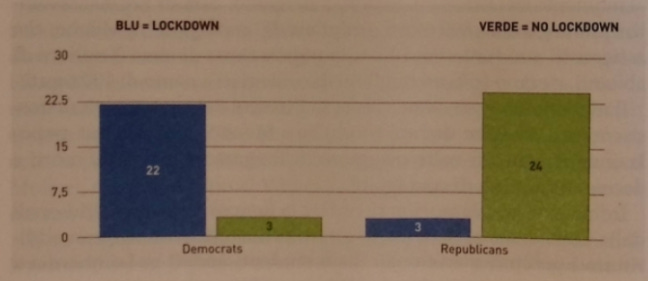
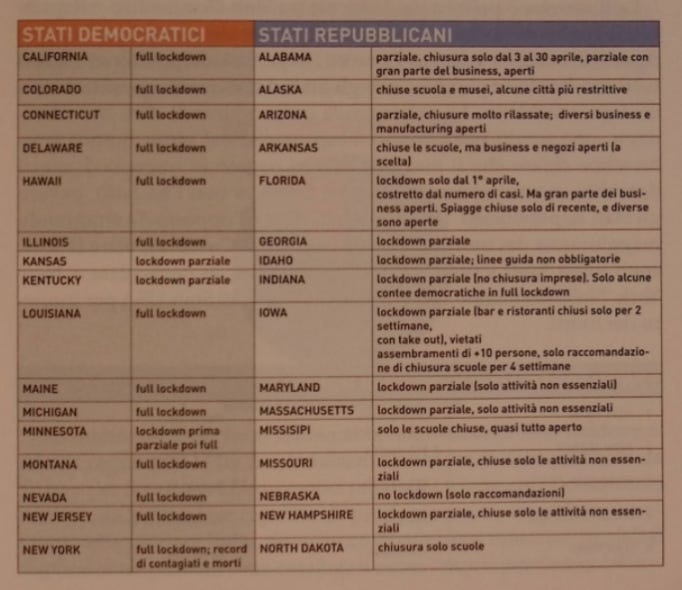
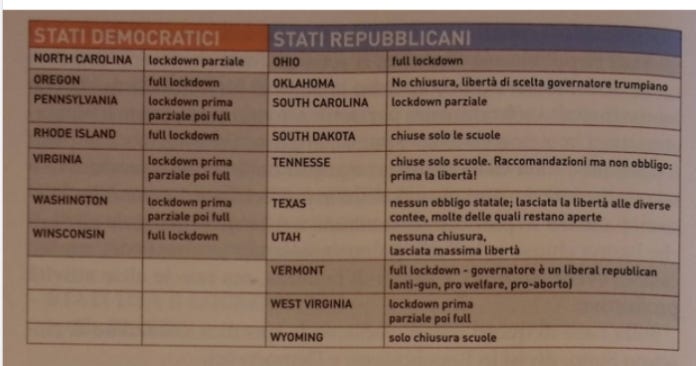
Let us define what is meant by full lockdown versus partial lockdown. Over time, virtually all U.S. states adopted some form of closure under pressure from the CDC/WHO‑aligned health system, the media, and Democratic mayors even within Republican‑governed states, but there were those—like New York—that imposed an early and total lockdown and others—like Massachusetts—that imposed only partial and later closures. A key distinguishing factor between full and partial lockdowns is whether or not productive and manufacturing activities were shut down: states that did so fall into the category of full lockdown, while those that closed only “non‑essential” activities—such as theaters, museums, casinos, sports events, and beauty salons—are counted as partial lockdown states.
On the basis of these criteria, we can examine the specific situation of each state, grouped into Republican and Democratic governance.
Deaths “With” Covid in the U.S.
The political distinction in lockdown policy between Democratic and Republican states is clear. The question now is: where is the greatest number of deaths “with” Covid—among the Republican states, which for the most part adopted only partial lockdowns, or among the Democratic states, nearly all of which adopted strict lockdowns? Pandemic propaganda tells us that lockdowns served to halt the spread of the virus, so the highest death toll should logically be found where lockdowns were not imposed, namely in Republican states.
Instead, the exact opposite occurred: the overwhelming majority of deaths attributed to Covid‑19 in the U.S.—over 90 percent—are in Democrat‑governed states, particularly New York, as illustrated by the list of the top ten U.S. states by number of deaths.
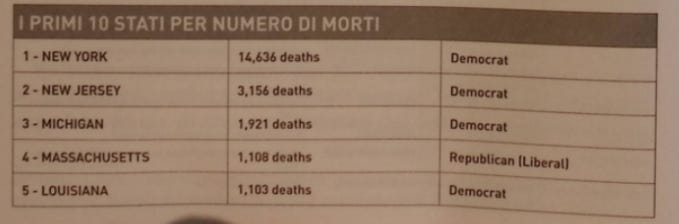
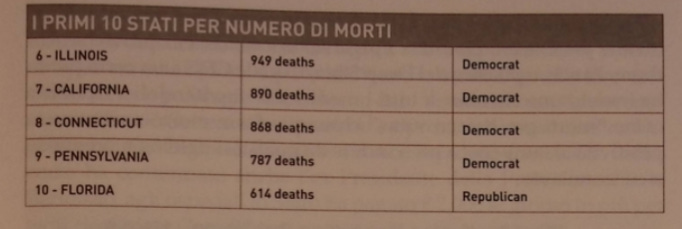
Of these ten states, only two—Massachusetts and Florida—are governed by Republicans: Florida is in tenth place with only 614 deaths, and Massachusetts also has a relatively limited number of deaths. Both Massachusetts and Florida resisted lockdowns for as long as possible and ultimately adopted only partial lockdowns, with many exceptions. The percentages show that out of the 26,032 deaths included in the table, 23,497—over 90 percent—occurred in Democratic states with early full lockdowns.
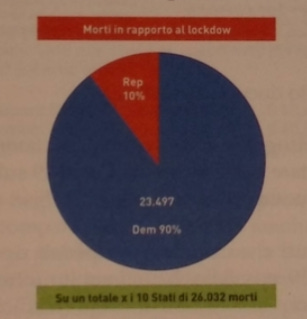
In short, it seems that people die in great numbers precisely where full lockdowns were imposed quickly. Either the virus was created by Trump to wipe out Democrats (ahahah…), or Democrats have a particular capacity for producing deaths—just as in “Piddina” Italy, where deaths of every kind and for every reason are promptly classified as “Covid‑19 deaths.”
CDC Guidance and Financial Incentives
Perhaps the solid connection between Democrats and the CDC (Centers for Disease Control—the organization from which Anthony Fauci comes and a pillar of the so‑called Deep State) has something to do with this, since at a certain point the CDC sent a circular to all U.S. physicians inviting them to report as “coronavirus deaths” anyone who died even without a positive test, regardless of previous or concurrent pathologies.
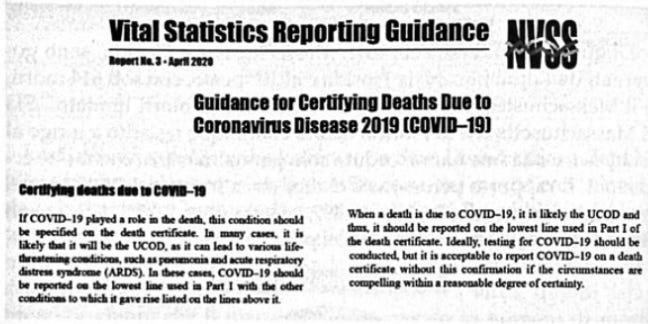
The official document reads:
“Ideally, testing should be performed, but it is acceptable to report a Covid‑19 death on the death certificate without this confirmation...”
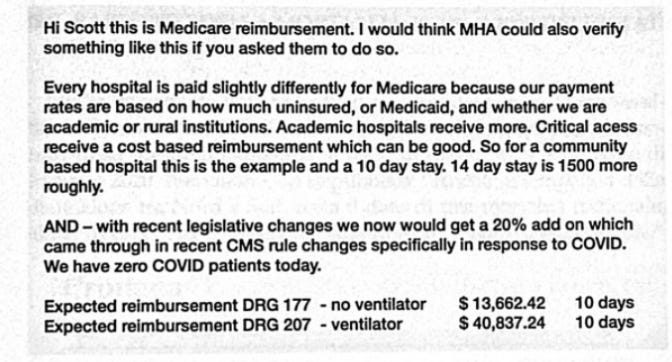
And to ensure that clinics and hospitals reported as many Covid‑19 deaths as possible, significant financial incentives were introduced immediately. Thus, the public insurers (Medicare, Medicaid) reimburse a clinic $13,622.42 if a person dies after ten days of hospitalization without needing a ventilator, whereas if the person dies after ventilator use—and thus with Covid‑19, since ventilator use is prescribed by the WHO protocol for Covid‑19—the clinic receives the much more substantial sum of $40,837.24.
The letter on the following page was sent to Senator Scott Jensen, a physician, who also testified that the administrative management of the clinic where he works explicitly requested that he report as Covid‑19 deaths even cases that had nothing to do with respiratory disease, given the enormous economic incentive to do so (letter and testimony reported by Del Bigtree’s HighWire). The same thing has happened and continues to happen in Italy: as former Civil Protection Chief Bertolaso confirmed, the State paid hospitals an extra €2,000 per day for every Covid‑hospitalized patient. 🦶 note 215
If the pandemic in the U.S. already appears hardly credible, in Italy ISTAT has tried to inflate mortality data that are completely inconsistent with the idea of a pandemic, through a series of manipulations in a document that all the national media repeated under the headline: “49% More Deaths!” In the document published in May 2020, I dismantled this conclusion, going through the numbers in detail and showing how ISTAT also deliberately manipulated the data.
🦶17 Hui M., “Rt: The number that can guide how societies ease coronavirus lockdowns,” Quartz, April 8, 2020.
🦶18 https://news.trust.org/item/20200130210003-wm57y/ now available here: https://www.reuters.com/article/business/autos-transportation/two-first-coronavirus-cases-confirmed-in-italy-prime-minister-idUSL8N29Z8LZ/
🦶19 https://bergamo.corriere.it/notizie/cronaca/20_febbraio_23/virus-primo-ca-so-bergamo-anziano-papa-giovanni-2b70f2dc-5648-11ea-b447-d9646dbdb12a.shtml < link did not work.. maybe this was the article? https://bergamo.corriere.it/notizie/cronaca/21_luglio_05/covid-cinese-val-seriana-sintomi-sospetti-gia-gennaio-2020-ma-non-ci-fu-nessun-tampone-6c4c8ff4-dd93-11eb-8676-1285755d8d46.shtml
🦶20 https://www.inuovivespri.it/2020/03/14/coronavirus-e-sabato-altralano-di-meridionali-del-nord-verso-il-sud-mattinale-459/ trying to find a viable link still
Thanks for sharing Renee. Some good info here on USA stats. Intersting points on South Dakota and school closures which was new to me. Seems to be very short lived. As we know 'COVID' stats are wide open to abuse to justify pandemia claims.
''South Dakota schools were able to begin the 2020-21 school year largely on time and in person.''
https://doe.sd.gov/publications/documents/CovidReport.pdf
‘'In New Zealand they were obviously using a very strict definition of what a COVID death was and that might further downstream have led to them declaring FEWER COVID deaths.’’
-Dr Ashley Croft. Scottish COVID-19 inquiry
https://biologyphenom.substack.com/p/newscottish-covid-19-inquiry23-sept?utm_source=publication-search